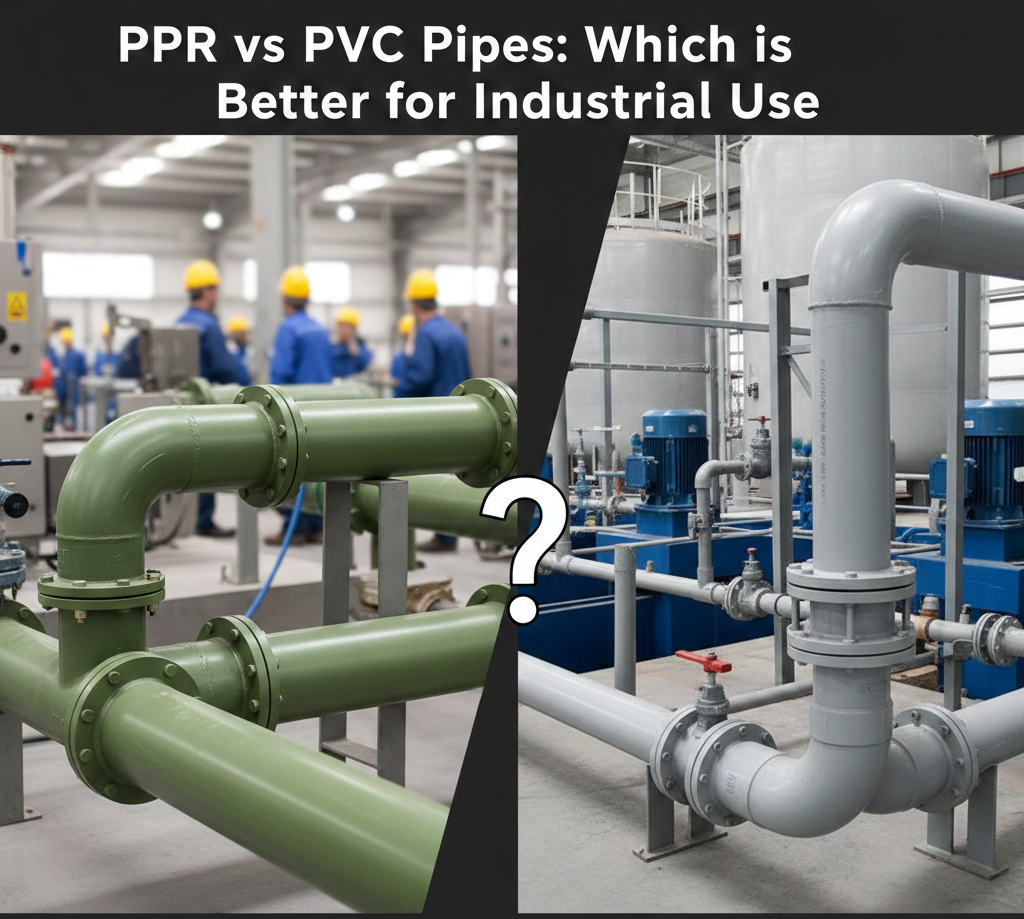
PPR vs PVC Pipes: Which is Better for Industrial Use?
Introduction
Choosing the right piping material is one of the most important decisions in any industrial project. Whether it’s a manufacturing plant, commercial building, hospital, hotel, or utility infrastructure, the performance of the piping system directly impacts safety, efficiency, and long-term maintenance costs.
Two of the most commonly used piping materials today are PPR
PPR (Polypropylene Random Copolymer)
and PVC (Polyvinyl Chloride). Both are widely used in water supply and industrial applications, but they differ significantly in strength, temperature resistance, durability, and cost.
In this detailed guide, we will compare PPR vs PVC pipes for industrial use, covering performance, lifespan, cost, installation, and real-world applications helping you choose the best option for your project.
Security
What Are PPR Pipes? Features and Industrial Applications
PPR pipes (Polypropylene Random Copolymer) are thermoplastic pipes designed for high-pressure and high-temperature applications.
Common Applications:
Hot and cold water supply systems
Industrial chemical transportation
Compressed air systems
HVAC piping networks
Utility and industrial projects
Key Features of PPR Pipes:
High temperature resistance (up to 95°C)
Corrosion-resistant and chemical-resistant
Long service life (50+ years)
Leak-proof heat fusion joints
Smooth inner surface for better flow
Because of their strong resistance to temperature and pressure, PPR pipes are often preferred in heavy-duty industrial environments.
What Are PVC Pipes? Features and Industrial Applications
PVC (Polyvinyl Chloride) pipes are one of the most widely used plastic piping materials in construction and infrastructure projects.
Common Applications:
Cold water supply systems
Drainage and sewage systems
Irrigation systems
Ventilation pipelines
Key Features of PVC Pipes:
Lightweight and easy to install
Cost-effective
Corrosion-resistant
Good chemical resistance
Suitable for low-temperature applications
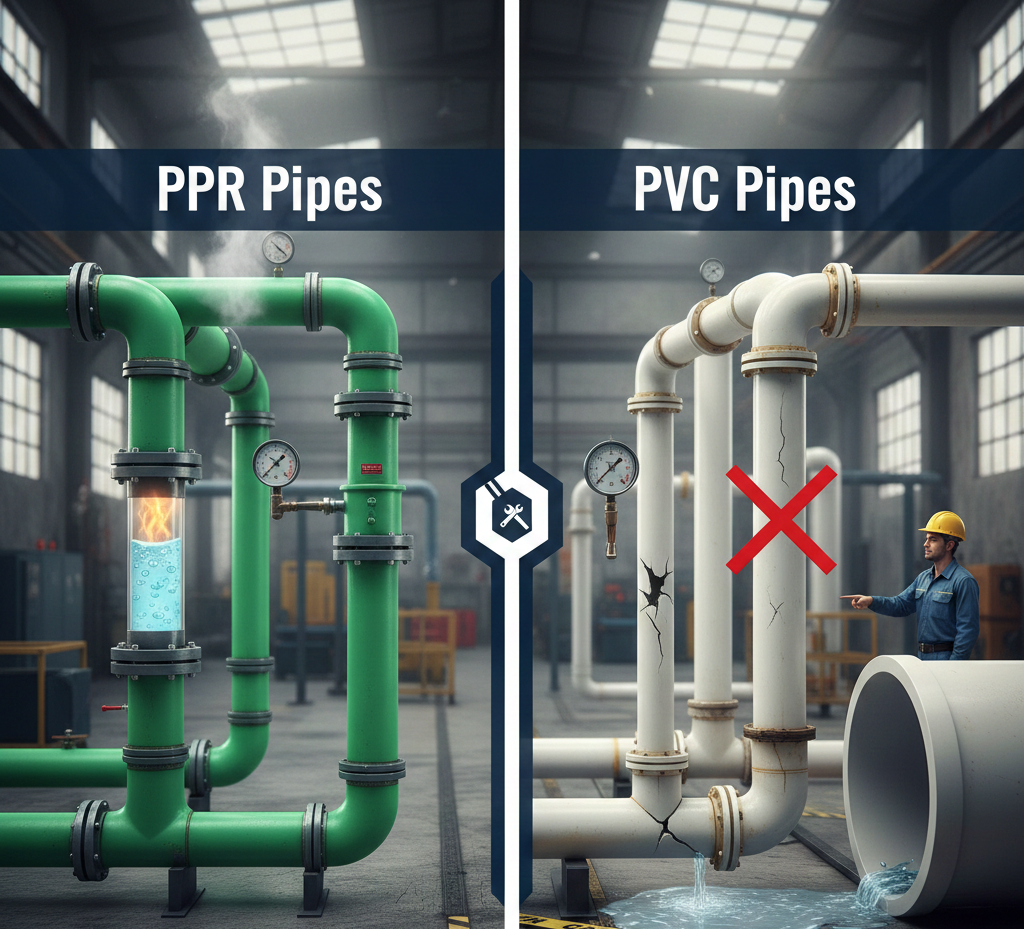
However, PVC pipes are not ideal for high-temperature or high-pressure industrial environments.
PPR vs PVC Pipes: Material Strength and Durability Comparison
PPR Pipes:
High impact resistance
Can handle high pressure
Resistant to scaling and corrosion
Suitable for long-term industrial use
PVC Pipes:
Strong but more brittle than PPR
May crack under high impact
Not suitable for extreme temperature conditions
For industries requiring long-lasting and pressure-resistant piping, PPR pipes offer better structural stability.
Temperature and Pressure Resistance: Which Performs Better?
PPR Pipes:
Can handle hot water up to 95°C
Suitable for high-pressure systems
Ideal for boiler connections and industrial heating
PVC Pipes:
Suitable mainly for cold water
Maximum temperature tolerance around 60°C
May deform under heat
If your industrial project involves hot water, steam-adjacent systems, or high pressure, PPR pipes are clearly the better choice.
Installation Process: Ease, Safety and Leak Protection
PPR Installation:
Uses heat fusion welding
Creates seamless, leak-proof joints
Stronger bonding than mechanical joints
Requires trained technicians
PVC Installation:
Uses solvent cement or rubber ring joints
Easier and faster installation
Lower labor cost
Higher risk of joint leakage over time
Lifespan and Maintenance Requirements
PPR Pipes:
50+ years lifespan
Minimal maintenance
Resistant to internal scaling
Suitable for concealed installations
PVC Pipes:
25–40 years lifespan
May become brittle over time
Requires inspection in pressure systems
Cost Comparison: Initial Investment vs Long-Term Value
PVC Pipes:
Lower initial cost
Affordable for small-scale or low-pressure projects
Budget-friendly option
PPR Pipes:
Higher upfront cost
Lower maintenance cost
Better long-term investment
Best Industrial Applications: Where to Use PPR and PVC
Choose PPR Pipes For:
Industrial hot water systems
Chemical processing plants
Compressed air systems
Commercial buildings
Hospitals and hotels
Choose PVC Pipes For:
Drainage systems
Irrigation networks
Low-pressure cold water supply
Vent pipelines
Conclusion
When comparing PPR vs PVC pipes for industrial use, the right choice depends on your specific project requirements.
If your industrial system demands high temperature resistance, strong pressure handling, long service life, and leak-proof connections, PPR pipes are the better long-term solution. However, for low-temperature, drainage, or budget-focused projects, PVC pipes remain a practical and cost-effective option.
For reliable and professional Utility & Industrial PPR Piping solutions, D'PARK CORPORATION
delivers quality, durability, and expert installation you can trust.