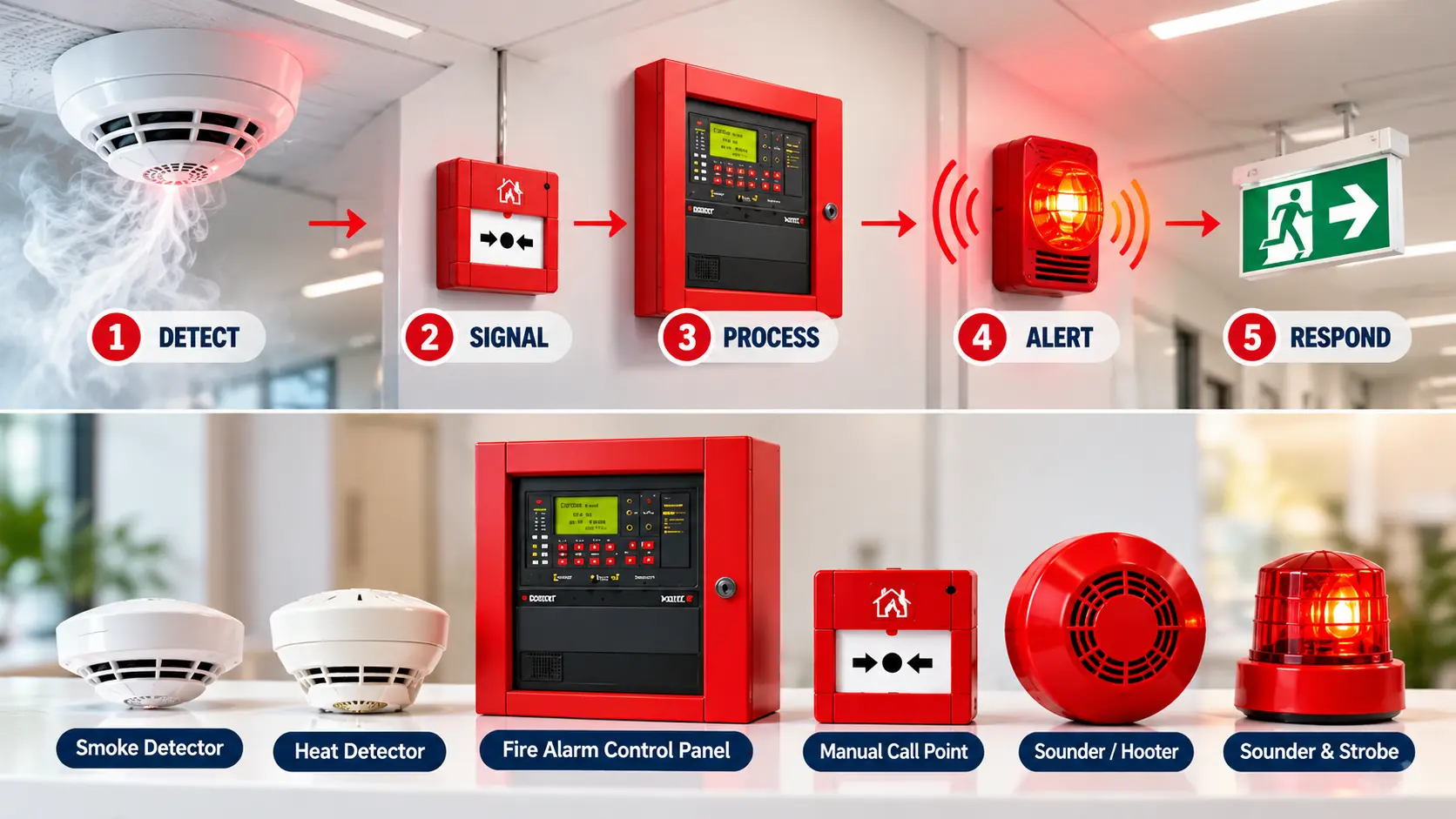
From smoke detectors and heat detectors to the fire alarm control panel, manual call points, sounders and strobes, every component has a specific role. Understanding how these devices work together can help property owners make better fire-safety decisions.
A fire alarm system is designed to detect conditions associated with fire and provide an early warning to people inside a building. Fire emergencies can develop quickly, and the sooner a potential fire is detected, the sooner people can be warned, and appropriate action can begin. This is where a well-designed fire alarm system becomes an essential part of building safety.
A fire alarm system is more than a single smoke detector or alarm bell. It is a coordinated network of detection, control, and notification devices designed to identify possible signs of fire and alert building occupants. Depending on the system design, automatic devices such as smoke and heat detectors can initiate an alarm. A person who notices a fire may also manually activate the system through a manual call point.
Once an initiating signal reaches the fire alarm control panel, the panel processes the information and activates the programmed notification devices or other connected functions.
A properly planned system can therefore support three important objectives:
Detect → Alert → Respond
However, a fire alarm system is only one part of an overall fire-safety strategy. Other fire safety equipment, such as fire extinguishers and hydrant systems, serves different purposes during a fire emergency.
One of the most common questions about fire alarm systems is: Which device actually detects the fire?
In many applications, the answer is a smoke detector or heat detector , depending on the type of detection selected for the area.
Smoke Detector
A smoke detector is designed to respond to the presence of smoke or combustion particles according to its detection technology. Because smoke can develop before conditions become severe, smoke detection is widely used for early warning in suitable environments.
Different detector technologies may be selected according to the application and expected fire characteristics.
Heat Detector
A heat detector responds to temperature conditions rather than smoke. Depending on its design, it may respond when a specified temperature is reached or when temperature rises according to defined criteria.
Heat detectors can be useful in environments where smoke detection may not be appropriate because of normal operating conditions.
It is important to understand that a fire alarm panel, manual call point and sounder/strobe do not perform the same automatic detection function . The panel processes signals, a manual call point allows a person to initiate an alarm, and notification appliances warn occupants.
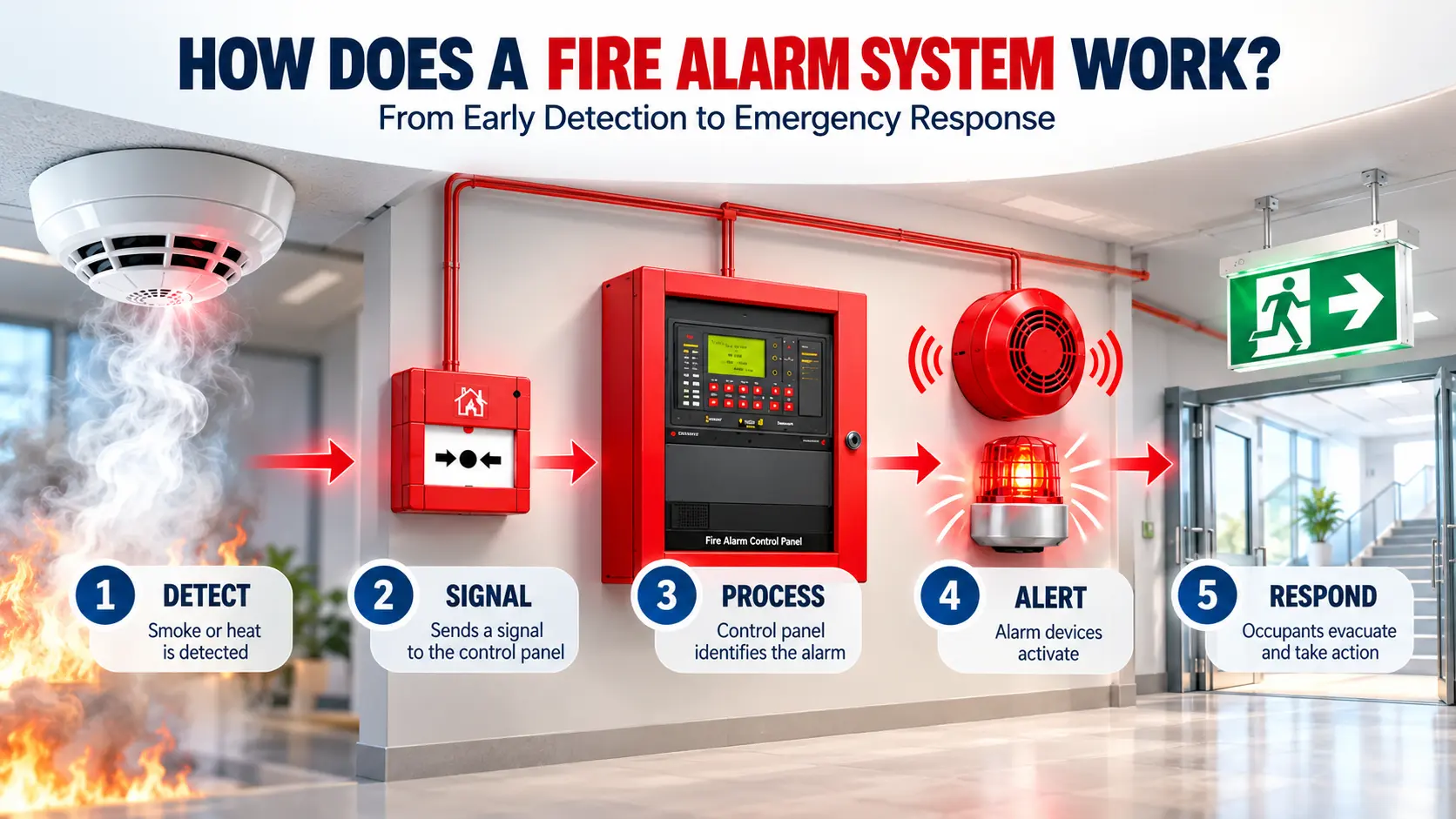
Although system configurations vary, the basic process can be understood in five stages.
Step 1: Detect
The process begins when an automatic detector identifies conditions associated with a possible fire.
A smoke detector may respond to smoke, while a heat detector responds to specified temperature conditions. This is why choosing the correct detector for each area is an important part of fire alarm system planning.
Step 2: Send the Signal
After activation, the initiating device sends a signal to the fire alarm control panel.
The way this information is communicated depends on the system architecture. In a conventional system, devices are typically arranged into zones. In an addressable system, compatible field devices have individual addresses that allow more specific identification.
Step 3: Process the Information
The fire alarm control panel acts as the central control point of the system.
It monitors connected circuits or devices and processes incoming signals. Based on the system's design and programming, it can indicate the alarm condition and initiate the appropriate outputs.
The panel can also display system conditions such as faults or other status information, depending on its capabilities.
Step 4: Alert Building Occupants
Once an alarm condition is initiated and processed, notification devices can activate.
Audible and visual warnings help notify occupants so that they can follow the building's emergency procedures.
Step 5: Respond
The purpose of early detection and warning is to support a timely response.
Occupants can begin evacuation according to the site's emergency plan, while designated personnel can follow established emergency procedures and contact emergency services as required.
The whole process can therefore be summarized as:
DETECT → SIGNAL → PROCESS → ALERT → RESPOND
A reliable fire alarm system depends on several devices working together rather than on one component alone.
Smoke Detector: Detects smoke or combustion particles using its specific sensing technology.
Heat Detector: Responds to specified temperature conditions.
Fire Alarm Control Panel: Receives and processes signals from connected initiating devices and controls programmed system responses.
Manual Call Point: Allows a person who discovers a fire to manually initiate an alarm.
Fire Alarm Sounder/Hooter: Produces an audible warning to alert occupants.
Sounder & Strobe: Combines audible and visual notification to enhance alarm awareness.
The exact selection and quantity of fire safety equipment should be based on the property's layout, occupancy, risk profile, applicable requirements and system design.
Two commonly used types of fire alarm system are conventional and addressable systems. While both are designed to support fire detection and warning, the way devices are organized and identified differs.
Conventional Fire Alarm System
A conventional fire alarm system generally divides a building into detection zones.
When a device within a zone initiates an alarm, the control panel identifies the affected zone. Personnel may then need to determine which individual device within that zone has activated. Conventional systems can be suitable for applications where zone-based identification meets the property's requirements.
Addressable Fire Alarm System
An addressable fire alarm system uses compatible individually addressed field devices on its communication loops.
When a device reports an event, the panel can identify that specific address and display more precise information based on the system configuration. This can make it easier to locate the source of an alarm or system event, particularly in larger or more complex facilities. The right choice between conventional and addressable technology depends on factors such as building size, layout, occupancy, project requirements, integration needs and applicable fire-safety standards.
A fire alarm system and a fire extinguisher are both important parts of fire safety, but they perform completely different functions.
A fire alarm system primarily supports detection, signalling and occupant warning. It helps people become aware of a potential fire so they can respond according to the emergency plan. A fire extinguisher, on the other hand, is firefighting equipment intended for controlling suitable early-stage fires when it is safe to do so and the correct type of extinguisher is used.
Therefore, one should not be treated as a replacement for the other. A broader fire-safety strategy may incorporate detection, alarm, evacuation planning and appropriate firefighting equipment.
Installing equipment alone does not automatically create an effective fire-safety system. Professional fire safety services can include site assessment, system planning, equipment selection, installation, testing, commissioning and ongoing maintenance.
A fire alarm system should be planned around the actual property rather than treated as a one-size-fits-all solution. Building layout, occupancy, environmental conditions, applicable codes and standards, and integration requirements can all influence the design.
Routine inspection, testing and maintenance are also important because fire safety equipment needs to remain operational when required.
Before selecting a fire alarm system, property owners and facility managers should consider:
A professional site assessment can help determine which configuration and fire safety equipment are appropriate for a specific property.
A fire alarm system creates a structured path from detection to warning. Detectors identify potential fire conditions, the control panel processes the signal, alarm devices warn occupants, and people can begin the appropriate emergency response.
Understanding the difference between a conventional fire alarm system, an addressable fire alarm system, detectors, notification devices and firefighting equipment such as a fire extinguisher can also help property owners make more informed fire-safety decisions.
For commercial, industrial, residential and institutional properties, the focus should be on a properly planned system supported by appropriate installation, testing and maintenance.
D'Park Corporation provides professional fire safety services and integrated fire-safety solutions for projects in Indore and across India.