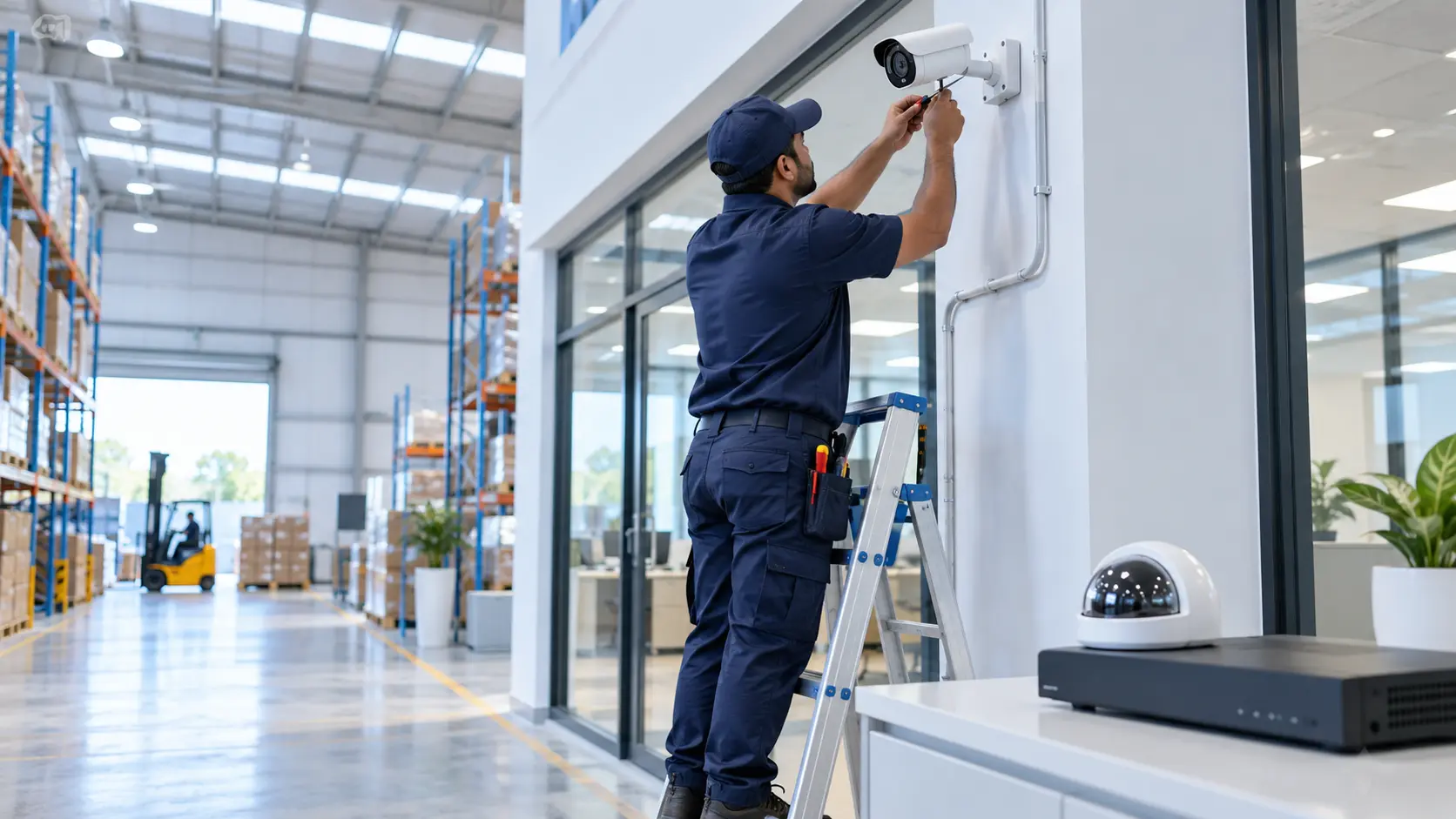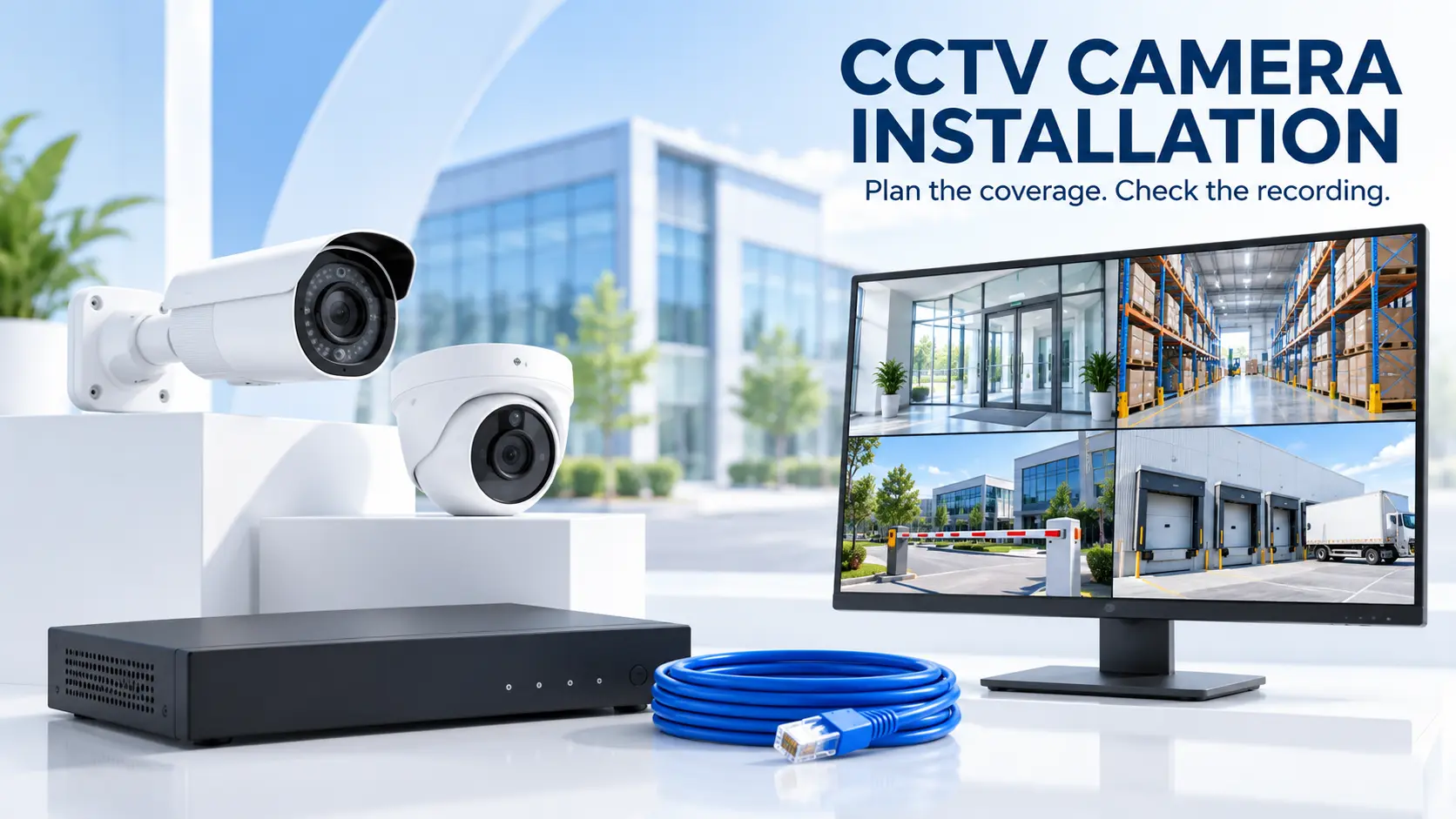
Your CCTV camera is working. The live view looks clear. But when you need to review an incident, the person’s face is too small, the entrance is overexposed, or the recording is missing. That is why CCTV camera installation deserves more attention than simply choosing cameras and mounting them on a wall.
A useful system starts with a straightforward question: What do you need to see, and why?
Whether you manage an office, factory, warehouse, shop, or residential society, this guide will help you plan a CCTV security system around your actual requirements.
Before asking how many cameras you need, identify the areas that matter most. For a shop, these might include the entrance, billing counter, and stockroom. A warehouse may need visibility across loading bays, access points and storage aisles. For a residential society, CCTV coverage often focuses on entry gates, parking spaces and common access points.
Consider a warehouse entrance. One camera may show that a vehicle arrived, but that view may not provide enough detail to identify a person entering beside it.
Different monitoring goals can require different camera positions and equipment.
A high-resolution camera cannot compensate for a blocked view or unsuitable angle. During CCTV installation, check for obstacles such as pillars, racks, signage, trees, and opening doors. Consider how the space is used throughout the day and how this may affect camera visibility.
An empty loading area may look easy to monitor. Once a truck parks there, it could block the camera’s view. Mounting height also involves a trade-off. A higher position may make a camera harder to reach, but an excessively steep angle can reduce useful facial detail.
A camera count alone does not tell you whether the property is well covered.
A camera that performs well at noon may produce a very different image after sunset. Bright sunlight behind a visitor, reflections from glass, and poorly lit corridors can all affect visibility. When discussing CCTV camera installation services , ask about performance in the actual location-not only the specifications printed on the box.
Features such as wide dynamic range, infrared illumination, or suitable low-light performance may help, depending on the camera and scene. However, equipment selection should account for distance, movement and available lighting. For example, seeing activity at a dark gate is different from capturing enough detail to identify someone walking through it.
Request a practical day-and-night check before accepting the installation.
Camera shape is only one part of system selection.
Bullet cameras are commonly used where directional monitoring is needed.Dome cameras and turret camera designs can suit a range of indoor and outdoor locations, depending on their specifications. PTZ cameras allow remote changes to viewing direction and zoom, but they do not continuously capture every direction at once.
Your provider should also explain the recording arrangement.
IP cameras transmit video over a network and may use an NVR or other compatible recording platform. Analogue systems commonly connect to a compatible DVR. The appropriate choice depends on your existing infrastructure, required features, and expansion plans.
For outdoor cameras, check suitability for weather exposure. For industrial locations, consider the installation environment and relevant equipment ratings. The right CCTV security system should fit your property-not simply follow a standard package.
Live viewing and reliable recording are separate requirements. You may be able to see every camera on a monitor while recordings are unavailable because of a storage fault or incorrect settings. Discuss how long footage needs to remain available and how it will be retrieved.
Avoid assuming that a particular hard-drive capacity always provides a fixed number of recording days. Also ask what happens when storage fills, how recording failures are detected, and how important clips can be exported.
A useful handover demonstration is simple: find a recording from an earlier time, play it back and export a sample clip.
Neat camera mounting is only the visible part of the installation. Cable routes, connectors, network equipment and power arrangements influence how reliably the complete system operates.
For compatible IP equipment, Power over Ethernet can carry power and data through the same network cable. Its suitability depends on the equipment, power requirements and installation design. Discuss backup power if monitoring during an outage matters to your property.
Remote viewing also needs careful setup. Use strong, unique passwords, appropriate user permissions, and manufacturer-supported security updates. Ask your provider to explain how remote access is secured. Not everyone who needs to watch live video needs permission to change settings or delete recordings.
Two quotations may list the same number of cameras while covering very different work. CCTV camera installation costs depend on the cameras selected, recording and storage needs, cable lengths, ease of installation, and system setup.
Compare the complete scope before choosing between quotations.
Searching for “CCTV camera installation near me” or “CCTV camera services near me” can help you find providers. The next step is checking whether they understand your site.
A useful discussion should go beyond camera prices. Ask whether the provider offers a site assessment, explains coverage limitations, supplies a clear quotation, and demonstrates recording and playback at handover.
Also clarify who handles faults and what ongoing support includes. Reliable CCTV installation services should leave you understanding how your system works and whom to contact when something needs attention.
Buildings change. New racks appear, entrances move, and landscaping grows. Review camera views when the layout changes. Routine maintenance should include checking image clarity, recording status, playback, time settings, and physical connections.
Keep lenses clean using suitable methods and review access permissions when staff responsibilities change. CCTV supports monitoring and incident review. Its usefulness depends on clear objectives, appropriate installation, and continued attention.
Planning CCTV for a new property or reviewing an existing system?
D'Park Corporation provides CCTV Security & Surveillance solutions for properties in Indore and across India, with services covering design, supply, installation, commissioning, and maintenance.
Share your property type, location, and monitoring requirements so the team can discuss a suitable approach.
How many CCTV cameras does my property need?
The number depends on the layout, monitoring objectives, obstacles, and detail required. A site assessment helps determine suitable coverage.
Can I view CCTV cameras on my phone?
Many systems support remote viewing. Availability depends on compatible equipment, connectivity, and secure configuration.
How long can CCTV footage be stored?
Retention depends on storage capacity, camera settings, and recording schedules. Ask for an estimate based on your proposed system.
Can an existing CCTV system be upgraded?
Often, yes. A technical assessment should check cameras, cabling, recording equipment, and compatibility before recommending changes.